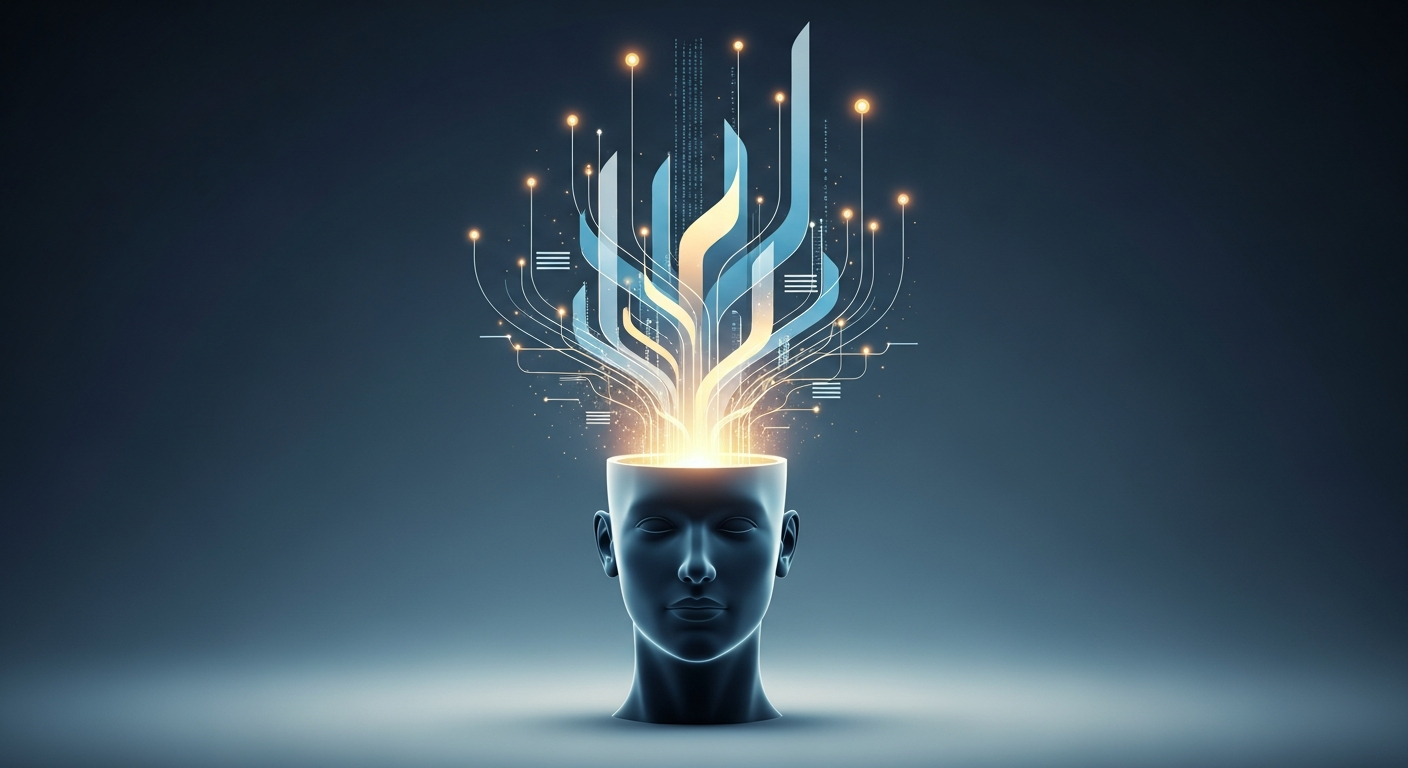
AI as the Architect of Augmented Human Cognition: Elevating Enterprise Decision-Making and Innovation
In the rapidly evolving landscape of artificial intelligence, many conversations center on automation, efficiency, and replacement. However, a far more profound and transformative application is emerging: AI as a powerful force for augmenting human cognition. For senior marketers, business leaders, and tech strategists, this isn't about robots doing our jobs; it's about AI elevating our innate human capabilities, enabling us to think sharper, innovate faster, and make decisions with unprecedented clarity and depth. At DigiIQ, we believe understanding this shift is crucial for pioneering the next era of enterprise success.
The New Frontier of Human-AI Symbiosis: Expanding Our Intellectual Horizon
Augmented cognition transcends simple data analysis or task automation. It’s about creating a symbiotic relationship where AI acts as an extension of the human mind, processing and synthesizing information at speeds and scales impossible for an individual. Imagine an AI not just crunching numbers, but actively highlighting previously unseen correlations in vast, disparate datasets, or simulating thousands of potential market scenarios in real-time. This isn't about outsourcing thought; it's about amplifying the human ability to perceive, process, and infer, allowing leaders to grasp complex situations with a comprehensive understanding previously unattainable.
This synergistic approach fundamentally redefines how we interact with information and challenges. Instead of being overwhelmed by data deluge, executives can leverage AI to distill critical insights, identify latent patterns, and surface outlier events that might otherwise go unnoticed. The AI becomes a tireless, objective co-pilot, expanding the cognitive bandwidth of human strategists, leading to a more nuanced and holistic view of enterprise challenges and opportunities.
Sharpening Strategic Decision-Making: Clarity in a Complex World
For leaders, robust decision-making is the cornerstone of progress. Augmented cognition directly impacts this by providing layers of intelligence that empower more informed choices. AI can meticulously analyze market trends, competitor actions, customer sentiment, and internal operational data, presenting a synthesized view that highlights key drivers and potential risks. It moves beyond descriptive analytics to prescriptive and even proscriptive recommendations, advising not just what happened, but what will happen and what should be done.
Consider the strategic implications: an AI-powered assistant can quickly simulate the downstream effects of a supply chain decision, predict customer response to a new marketing campaign, or model the financial impact of a new product launch across various economic conditions. This dramatically reduces the guesswork inherent in high-stakes decisions. Furthermore, AI can be trained to identify cognitive biases – confirmation bias, anchoring bias, groupthink – within the decision-making process itself, prompting leaders to consider alternative perspectives and challenge preconceived notions. This isn't about replacing human intuition, but buttressing it with data-driven objectivity.
Actionable Takeaway: Implement AI-powered decision support systems that offer real-time scenario modeling and predictive analytics. Encourage leadership teams to engage with these tools to test assumptions and explore counter-factuals before committing to a strategic path.
Fueling Innovation and Creativity: The AI Co-Creator
Innovation often springs from novel connections and fresh perspectives. Here, augmented cognition truly shines. Generative AI, for example, can act as a tireless brainstorming partner, creating countless permutations of product designs, marketing copy, or business models based on specific parameters. It can explore vast solution spaces far beyond human capacity, surfacing surprising and unique ideas that a human might never conceive independently.
Beyond ideation, AI can accelerate the entire R&D lifecycle. In fields like materials science or drug discovery, AI can analyze vast scientific literature, identify promising molecular structures, predict their properties, and even design experiments – drastically shortening the time from hypothesis to discovery. For marketers, AI can generate hyper-personalized content variations, test them in micro-segments, and learn what resonates most effectively, feeding back insights that fuel subsequent creative campaigns. This capability is further amplified by AI content repurposing strategies, allowing businesses to multiply their reach without constantly creating new content.
This doesn't diminish human creativity; it supercharges it. By offloading the arduous tasks of data synthesis, pattern recognition, and initial concept generation to AI, human innovators are freed to focus on higher-order creative thinking, strategic refinement, and the empathetic understanding that only humans possess. AI becomes the brush and palette, while the human remains the artist.
Actionable Takeaway: Integrate generative AI tools into R&D, product development, and marketing teams. Task AI with generating initial concepts, exploring design variations, or analyzing vast datasets for novel connections, freeing human experts for refinement and strategic direction.
Overcoming Cognitive Overload and Bias: The Intelligent Filter
Modern business leaders are drowning in information. Emails, reports, market data, social media feeds – the sheer volume can lead to cognitive overload, fatigue, and suboptimal decisions. Augmented cognition systems can act as intelligent filters, prioritizing information, summarizing key documents, and proactively flagging critical updates relevant to a leader's specific objectives and priorities. This ensures that valuable cognitive energy is directed where it matters most, reducing the mental burden of sifting through noise.
Moreover, AI offers a powerful antidote to human cognitive biases. Every individual carries inherent biases, shaped by experience and psychology, which can unconsciously skew judgment. AI, when properly designed and trained, can identify these biases in data sets or even in human decision patterns. For instance, an AI might highlight that a hiring committee consistently favors candidates from certain backgrounds, or that investment decisions are unduly influenced by recent market performance rather than long-term indicators. By making these biases explicit, AI enables leaders to confront and mitigate them, fostering fairer, more objective, and ultimately more effective decision-making across the enterprise.
Actionable Takeaway: Deploy AI-powered executive assistants and intelligence platforms that distill vast information into actionable insights, prioritizing based on strategic objectives. Implement AI tools designed to detect and flag potential cognitive biases in decision-making processes.
Implementing Augmented Cognition: A Strategic Blueprint for Leaders
Embarking on the journey of augmented cognition requires a deliberate and strategic approach. It's not just about acquiring AI tools; it's about integrating them into the very fabric of how your organization thinks and operates. First, leaders must champion a culture of human-AI collaboration, emphasizing that AI is there to enhance, not replace. Invest in robust data infrastructure capable of feeding diverse, high-quality information to AI systems. Data integrity and accessibility are paramount.
Second, focus on talent development. Upskill your workforce to effectively leverage AI tools, fostering 'AI literacy' across all levels, especially for those in decision-making roles. This involves training on prompt engineering, understanding AI outputs, and critically evaluating AI-generated insights. Third, establish clear ethical guidelines and governance frameworks for AI deployment, ensuring fairness, transparency, and accountability. Pilot projects focused on specific high-impact decision areas or innovation bottlenecks can provide valuable learning and demonstrate ROI, paving the way for broader adoption.
Actionable Takeaway: Begin with pilot programs in critical decision areas, focusing on demonstrating clear value. Invest in "AI literacy" training for leadership and key teams, emphasizing the collaborative aspect of human-AI intelligence. Establish ethical guidelines early.