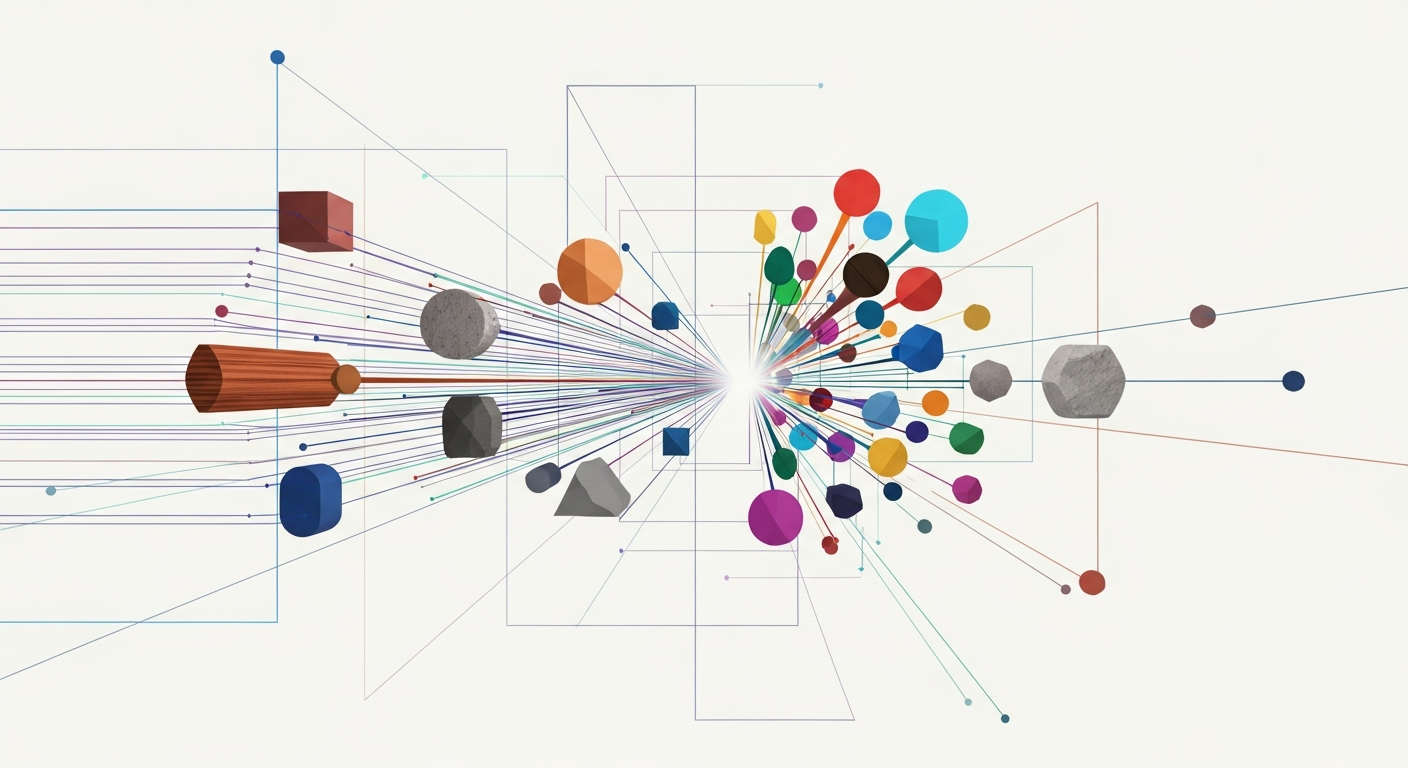
In the relentless pursuit of competitive advantage, businesses often focus on optimizing efficiency, streamlining processes, and predicting market trends. Yet, some of the most profound breakthroughs and pivotal strategies emerge not from linear analysis, but from serendipitous moments – unexpected connections, chance encounters, or sudden insights that spark revolutionary ideas. For too long, organizations have left serendipity to fate. What if we could systematically cultivate it? Enter AI, not just as an efficiency engine, but as the architect of enterprise serendipity.
Enterprise serendipity, in this context, refers to the intentional design and leveraging of AI systems to generate non-obvious, valuable connections between disparate data, ideas, and people, leading to unforeseen innovations, strategic advantages, and accelerated problem-solving. It's about moving beyond simply finding what you're looking for, to uncovering what you didn't even know to search for – but desperately needed.
Harnessing the Unseen: AI as a Connection Engine
Traditional data analytics excels at identifying known patterns and answering specific questions. However, the true power of AI in fostering serendipity lies in its capacity to process, interpret, and link vast, heterogeneous datasets that no human could reasonably synthesize. Imagine AI systems ingesting internal R&D reports, customer feedback transcripts, global market research, academic papers, patent filings, social media trends, and even employee skill profiles. AI can then identify weak signals, latent patterns, and non-obvious correlations across these seemingly unrelated domains.
This goes beyond simple keyword matching. Advanced AI, particularly with natural language processing (NLP) and graph neural networks, can understand the semantic relationships between concepts, bridging disciplinary silos and connecting abstract ideas. For instance, an AI might link an obscure material science discovery with an unmet customer need in a completely different industry, or connect an internal process inefficiency with a solution from an entirely unrelated field. This unique ability to traverse and synthesize knowledge graphs is what transforms serendipity from a rare occurrence into a strategic asset. Such transformative capabilities are at the heart of how generative AI is transforming digital communication for modern businesses, enabling dynamic and scalable content strategies.
The Innovation Accelerator: Outcomes of Engineered Serendipity
The practical implications of AI-driven serendipity are profound and far-reaching, directly impacting a leader's ability to innovate and maintain market leadership:
- Product & Service Innovation: AI can suggest novel combinations of existing technologies or identify unmet needs that a current product could unexpectedly address. Imagine an AI proposing a new feature for a software platform by correlating user complaints about a competitor's product with an internal, unused algorithmic capability.
- Market & Strategic Foresight: By connecting seemingly unrelated geopolitical events, social trends, and technological advancements, AI can reveal emerging market opportunities or existential threats that human analysts might miss until it's too late. This provides a crucial lead time for strategic pivots.
- Operational Excellence: AI can uncover cross-departmental synergies, highlighting how a process improvement in one area could unexpectedly benefit another, or how underutilized resources could be redeployed for maximum impact.
- Talent & Collaboration: Beyond typical HR analytics, AI can suggest unlikely pairings of individuals with complementary, yet seemingly disparate, expertise for innovative project teams. This fosters a dynamic internal ecosystem where diverse perspectives naturally converge.
For senior marketers, this means identifying nascent consumer desires before competitors; for business leaders, it means uncovering new revenue streams or optimizing supply chains in unprecedented ways; and for tech strategists, it signifies building platforms that aren't just intelligent, but also inherently creative in their capacity for discovery. This drive for creativity and reach is further amplified by AI content repurposing, helping businesses multiply their reach without constantly creating new material from scratch, thereby improving SEO and engagement across platforms.
Architecting Serendipity: Practical Implementation for Leaders
Cultivating AI-driven serendipity isn't about passive observation; it requires intentional design and strategic investment. Here’s how leaders can begin to architect these moments within their organizations:
- Unified Knowledge Graphs: The foundational step is to create a comprehensive, interconnected knowledge graph that spans all enterprise data – structured and unstructured. This allows AI to freely traverse and link information across departments, projects, and external sources. Invest in semantic technologies that can establish meaningful relationships between data points.
- Intelligent Prompting & Querying Systems: Develop AI interfaces that encourage exploratory questioning. Instead of asking "Find X," enable users to ask "What are unexpected connections between Y and Z?" or "What are the hidden implications of data point A on our strategy B?" Train AI to identify anomalies or suggest "what if" scenarios.
- Cross-Pollination Algorithms: Implement AI algorithms specifically designed to suggest unlikely pairings of people, projects, or data points. These systems could function like an internal "innovation matchmaker," presenting leadership with novel combinations for consideration.
- AI-Powered "Discovery Boards": Create virtual spaces where AI regularly presents potential serendipitous connections, anomalies, or nascent trends for human validation, discussion, and ideation. These boards can serve as catalysts for cross-functional brainstorming sessions.
- Culture of Experimentation: Crucially, foster an organizational culture that values curiosity, experimentation, and the exploration of AI-generated insights, even those that initially seem counterintuitive. Encourage hypothesis testing and rapid prototyping of serendipitous discoveries.
Leaders must actively promote cross-functional dialogue and allocate resources for exploring AI's 'aha!' moments, transforming potential into tangible innovation.
Navigating the Nuances: Ethics, Bias, and Human Oversight
While the promise of AI-driven serendipity is immense, it's vital to acknowledge potential challenges. AI systems are only as unbiased as the data they are trained on. Biased input could lead to reinforced prejudices or narrow, rather than novel, insights. Therefore, robust AI governance frameworks are essential.
Organizations must prioritize transparent AI models, ensuring that the "why" behind a serendipitous connection can be understood and audited. Human-in-the-loop validation remains critical; AI can suggest, but human intuition, ethical reasoning, and domain expertise are indispensable for discerning true value from noise. Data privacy and ethical data use must be paramount, especially when connecting disparate datasets. Implementing safeguards against algorithmic discrimination and ensuring diverse human oversight will be key to harnessing serendipity responsibly and effectively.
Conclusion
AI's role is evolving beyond automation and prediction; it's becoming a catalyst for creativity, discovery, and unforeseen advantage. By proactively architecting enterprise serendipity, businesses can transform serendipitous moments from rare occurrences into a systematic source of innovation and strategic insight. Embracing this new horizon of AI means not just working smarter, but discovering entirely new ways to win. The future of innovation belongs to those who learn to engineer their own luck with intelligent design.