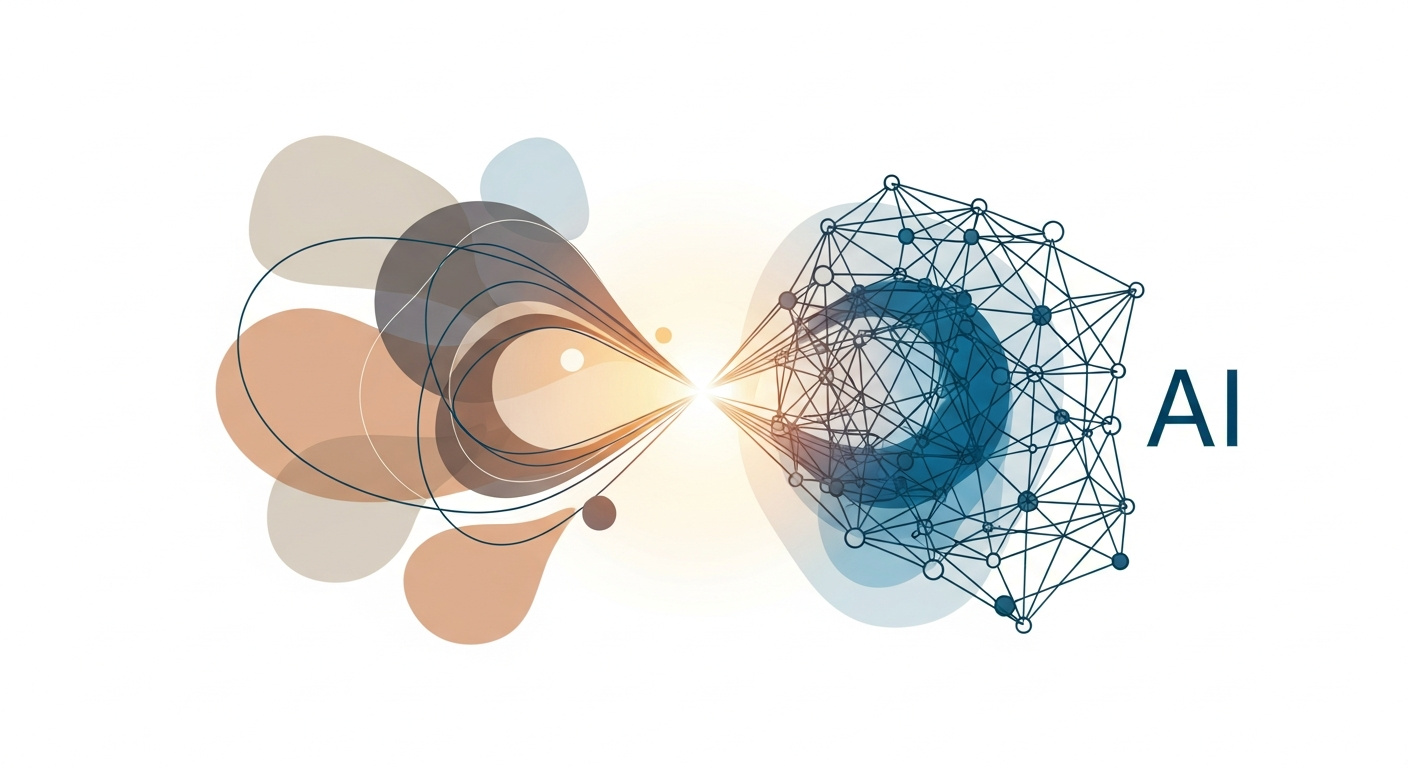
For decades, AI's promise primarily revolved around automation, efficiency, and data analysis. While these applications have been transformative, a new frontier is emerging: AI as a powerful partner in human creativity and innovation. This isn't about AI replacing human ingenuity, but rather augmenting it, propelling us into an era of synergistic discovery where the sum is truly greater than its parts. For senior marketers, business leaders, and tech strategists, understanding and harnessing this paradigm shift is crucial for staying competitive and forging new pathways to value creation.
Shifting Paradigms: AI as a Creative Co-Pilot
The traditional view often positions AI as a tool for executing creative tasks, such as generating marketing copy or designing graphics. While valuable, this perspective undersells AI's true potential. The cutting edge sees AI not just as a generator of outputs, but as an integral co-pilot in the upstream creative process – from brainstorming and conceptualization to problem reframing and novel solution identification. It's about leveraging AI to expand the boundaries of what humans can imagine and achieve, facilitating a dialogue between human intuition and AI's computational prowess.
This shift represents a fundamental change in how we approach innovation. Instead of viewing AI as merely a logical or analytical engine, we now recognize its capacity to inspire, challenge, and connect disparate ideas in ways that elude human cognitive biases and limitations. It's about moving from AI-powered automation to AI-augmented cognition, where complex problems are tackled with enhanced foresight and a wider spectrum of creative possibilities.
The Core Mechanics of Synergistic Discovery
How does AI achieve this augmentation? Its power lies in several key mechanisms:
- Pattern Recognition at Scale: AI can rapidly process and identify subtle patterns, correlations, and anomalies across colossal datasets – market trends, consumer behaviors, scientific literature, design principles, competitor strategies – that would be impossible for humans to discern. This allows for the discovery of unforeseen connections, sparking novel ideas.
- Rapid Ideation & Prototyping: Acting as a tireless brainstorming partner, AI can generate thousands of diverse ideas, concepts, and scenarios in minutes. From marketing campaign angles to product feature permutations, it provides a vast sandbox for human refinement and selection, dramatically accelerating the ideation cycle.
- Perspective Broadening: AI models can be trained on diverse datasets from different industries or cultural contexts. When prompted, they can offer entirely new frameworks or lenses through which to view a problem, challenging conventional wisdom and pushing human thinkers beyond familiar mental models.
- Constraint-Based Innovation: AI excels at exploring a solution space under specific constraints. For example, designing a sustainable product with limited materials and a target cost, AI can rapidly iterate designs that meet these complex parameters, often revealing ingenious compromises or breakthroughs.
Real-World Impact: Unleashing Innovation Across Sectors
The implications for business are profound and cross-disciplinary:
- Marketing & Brand Strategy: Beyond hyper-personalization, AI can co-create entirely novel campaign concepts, sculpt unique brand narratives, and design immersive customer experiences based on emergent cultural trends and emotional insights. Imagine AI assisting in developing entirely new product categories that resonate with unarticulated consumer desires.
- Product Development & R&D: Accelerate the discovery of new materials, chemical compounds, or software architectures. AI can explore unconventional design combinations, simulate performance, and identify optimal solutions faster than traditional methods, leading to groundbreaking products and services. For instance, in pharmaceuticals, AI helps pinpoint new drug candidates.
- Strategic Planning & Foresight: Leaders can leverage AI to model complex future scenarios, identify unforeseen risks and opportunities, and even generate 'blue ocean' strategies. AI's ability to synthesize vast amounts of geopolitical, economic, and technological data allows for more robust and imaginative strategic foresight, helping businesses proactively sculpt their future rather than merely reacting to it.
Architecting a Creative AI Strategy for Your Organization
Integrating AI for augmented creativity requires a deliberate, strategic approach:
- Foster a Culture of Experimentation: Encourage teams to explore AI tools as creative partners, not just as task completers. Dedicate resources for pilot projects and internal hackathons focused on AI-augmented ideation.
- Invest in Diverse AI Tools & Platforms: Look beyond generic large language models. Explore specialized AI tools for design, material science, narrative generation, or strategic simulation. The right tool for the right creative challenge is key.
- Train Teams in Human-AI Collaboration: Develop new skill sets for 'prompt engineering,' critical evaluation of AI outputs, and the ability to iteratively guide AI models towards desired creative outcomes. This is a dialogue, not a dictation.
- Define Clear Ethical Guidelines & IP Considerations: Establish policies for ownership of AI-generated content, ensure responsible data use, and mitigate biases that could stifle true innovation or lead to unethical outputs. Transparency is paramount.
Navigating the New Creative Frontier
As we embrace AI as a creative collaborator, questions about originality, human agency, and the very definition of creativity will continue to evolve. The key is to view AI not as a threat to human ingenuity, but as its ultimate amplifier. By designing ethical frameworks, fostering continuous learning, and focusing on the symbiotic relationship, organizations can navigate this new frontier. The future of innovation isn't about humans OR AI; it's about humans AND AI, working in concert to discover realities we can only just begin to imagine.