The digital economy is entering a new era where content is no longer created only for visibility. It is now engineered for engagement, personalization, scalability, and intelligent business growth. Brands across industries are realizing that traditional content workflows cannot keep pace with the speed of modern communication demands. Consumers expect faster responses, immersive experiences, multilingual accessibility, and personalized interactions across every touchpoint.
This transformation is fueling the rise of intelligent content ecosystems powered by artificial intelligence. Businesses are no longer asking whether AI should become part of their content operations. Instead, they are exploring how quickly they can integrate AI-powered systems into marketing, sales, training, branding, and customer engagement strategies.
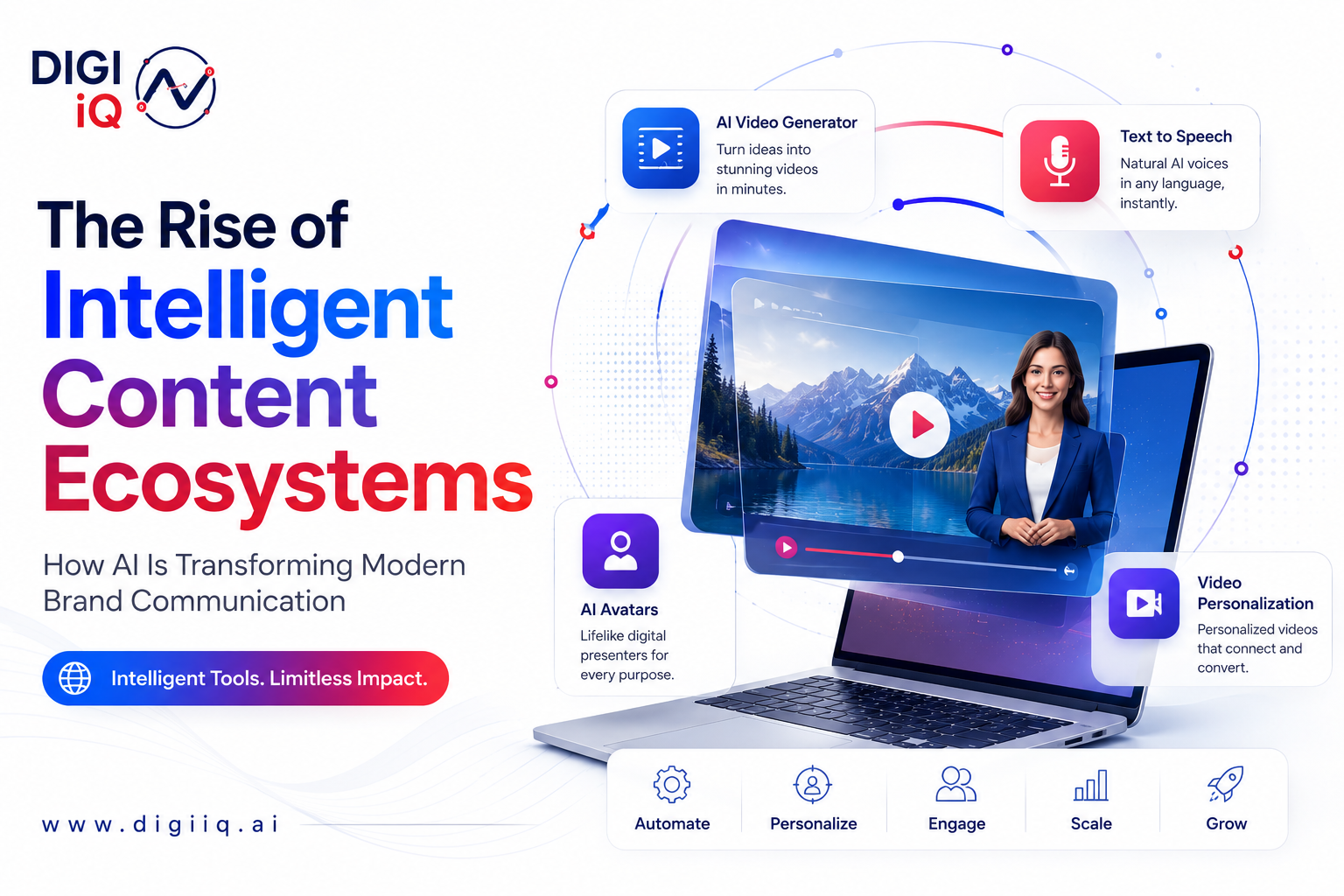
At the center of this evolution, DigiiQ.ai is helping businesses reimagine how content is conceptualized, produced, distributed, and optimized. By combining AI Video Generator capabilities, advanced Text to Speech technology, scalable Video Personalization, and realistic AI Avatars, modern organizations can now create enterprise-grade communication systems that operate with speed, consistency, and intelligence.
The Shift From Static Content to Dynamic Intelligence
For years, digital content followed a predictable structure. Businesses created blogs, advertisements, brochures, videos, and social media campaigns using separate teams, fragmented workflows, and time-consuming production pipelines. While effective in earlier digital environments, these systems now struggle to meet the demands of hyper-personalized global audiences.
The rise of AI-driven platforms is fundamentally changing this model. Content is becoming adaptive rather than static. Instead of producing one generic message for all audiences, companies can now create intelligent campaigns that evolve based on user behavior, preferences, location, language, and engagement patterns.
This shift is particularly important in industries where communication speed directly influences customer trust and business growth. Companies in technology, healthcare, education, finance, real estate, and e-commerce are adopting AI solutions to automate repetitive production processes while increasing personalization quality.
The future of communication belongs to brands capable of delivering scalable experiences without losing authenticity. This is precisely where intelligent AI ecosystems are creating a competitive advantage.
AI Video Generation Is Redefining Creative Production
Video has become the dominant language of the internet. However, traditional video production often involves expensive equipment, lengthy editing cycles, creative bottlenecks, and large operational costs. Businesses seeking continuous video production for marketing campaigns, product launches, onboarding, customer support, and social media frequently face scalability challenges.
AI Video Generator technology is transforming this reality by allowing organizations to convert text-based ideas into studio-quality videos within minutes. Instead of coordinating complex production teams, brands can automate major parts of the video creation process while maintaining professional visual quality.
This transformation is not simply about speed. It is about unlocking creative flexibility. Marketing teams can test multiple campaign variations instantly. Sales organizations can generate localized product presentations for different regions. Training departments can create learning content without depending on traditional filming infrastructure.
The ability to rapidly generate visual content is changing how brands interact with audiences in real time. Businesses that once struggled to maintain consistent video output can now produce large-scale visual campaigns with remarkable efficiency.
The Growing Importance of Human-Like Digital Communication
As automation expands, consumers increasingly value communication that feels natural and emotionally engaging. Robotic messaging often creates disconnects between brands and audiences. Modern AI systems are solving this problem by making digital interactions more human-centric.
Advanced Text to Speech technology now enables businesses to generate realistic voiceovers that sound expressive, conversational, and emotionally aligned with brand identity. Companies no longer need expensive recording studios or lengthy voice production timelines to create multilingual narration for videos, advertisements, podcasts, training materials, and customer support content.
This advancement is especially powerful for global organizations seeking localization at scale. Businesses can create region-specific content faster while maintaining brand consistency across languages and markets.
The integration of AI Avatars further enhances this experience. Realistic digital presenters can communicate brand messages, deliver tutorials, guide customer journeys, and represent businesses in virtual environments. Unlike traditional presenters, AI avatars can operate continuously across multiple campaigns without logistical constraints.
The result is a new form of communication where automation and personalization coexist seamlessly.
Personalization Is Becoming the Core of Customer Experience
Modern audiences expect brands to understand their preferences, needs, and behaviors. Generic communication strategies are rapidly losing effectiveness as consumers gravitate toward experiences that feel tailored and relevant.
Video Personalization is emerging as one of the most influential innovations in modern marketing and customer engagement. AI-powered personalization allows businesses to create individualized content experiences at scale without manually producing separate campaigns for every audience segment.
A retail company can deliver personalized product recommendations through dynamic video campaigns. Educational institutions can create individualized learning experiences for students. Financial service providers can generate customized onboarding videos based on customer profiles. Healthcare organizations can simplify patient communication using adaptive visual explanations.
Personalization is no longer limited to email greetings or targeted advertisements. AI is enabling fully customized multimedia experiences that strengthen customer relationships and increase engagement rates.
As businesses compete for attention in crowded digital markets, personalized communication is becoming one of the strongest drivers of long-term brand loyalty.
Why Businesses Are Investing in AI Content Infrastructure
The adoption of AI-powered communication systems is accelerating because businesses are recognizing the long-term operational value of intelligent automation. AI does not simply reduce workload. It creates scalable infrastructure capable of supporting continuous digital growth.
Organizations using integrated AI ecosystems can reduce production timelines, optimize resource allocation, improve campaign consistency, and accelerate content delivery across multiple channels simultaneously.
The ability to automate repetitive creative tasks allows human teams to focus on strategic innovation instead of manual production bottlenecks. Marketing departments can prioritize storytelling and campaign strategy while AI handles rendering, adaptation, localization, and optimization.
For startups, AI creates opportunities to compete with larger enterprises without requiring massive production budgets. For enterprise organizations, AI improves operational efficiency while supporting global-scale communication demands.
This transition is reshaping digital transformation strategies across industries worldwide.
AI and the Future of Brand Identity
One of the most fascinating developments in artificial intelligence is its influence on brand identity itself. AI is no longer just supporting communication processes. It is actively shaping how brands present themselves visually, verbally, and emotionally.
Businesses are beginning to create consistent AI-powered brand ecosystems where voice tone, visual storytelling, avatar identity, and messaging style operate cohesively across all customer interactions.
This creates stronger recognition and more immersive digital experiences. Customers interacting with AI-powered systems increasingly perceive brands as responsive, intelligent, and technologically advanced.
As virtual environments, immersive media, and interactive experiences continue to evolve, AI-driven identity systems will become even more important. Brands capable of creating seamless digital personalities will likely dominate future engagement landscapes.
The companies investing in intelligent communication today are positioning themselves for the next generation of digital interaction.
The Role of AI in Global Business Expansion
Global expansion traditionally required significant localization investments, multilingual teams, regional content strategies, and operational complexity. AI is dramatically simplifying this process.
Through automated translation systems, realistic voice generation, personalized video creation, and AI avatars, businesses can now scale internationally faster than ever before.
Companies entering new markets can create culturally adaptive campaigns without rebuilding production systems from scratch. Training materials can be translated instantly. Product demonstrations can be localized efficiently. Customer engagement can become region-specific while maintaining centralized operational control.
This capability is especially important in a global economy where digital accessibility directly impacts business growth opportunities.
AI-powered content ecosystems are enabling organizations to think globally from the very beginning.
Conclusion
The future of digital communication will not be driven by isolated content pieces or fragmented production systems. It will be shaped by intelligent ecosystems capable of creating adaptive, scalable, and personalized experiences across every stage of the customer journey.
Artificial intelligence is transforming how businesses produce videos, deliver voice experiences, personalize communication, and build digital identities. Technologies like AI Video Generator systems, Text to Speech platforms, Video Personalization engines, and AI Avatars are no longer experimental innovations. They are becoming foundational components of modern business infrastructure.
DigiiQ.ai represents this new generation of intelligent communication platforms, empowering organizations to create faster, scale smarter, and engage audiences more effectively in an increasingly competitive digital landscape.
As technology continues to evolve, the brands that embrace AI-driven content ecosystems today will define the future of customer engagement tomorrow.