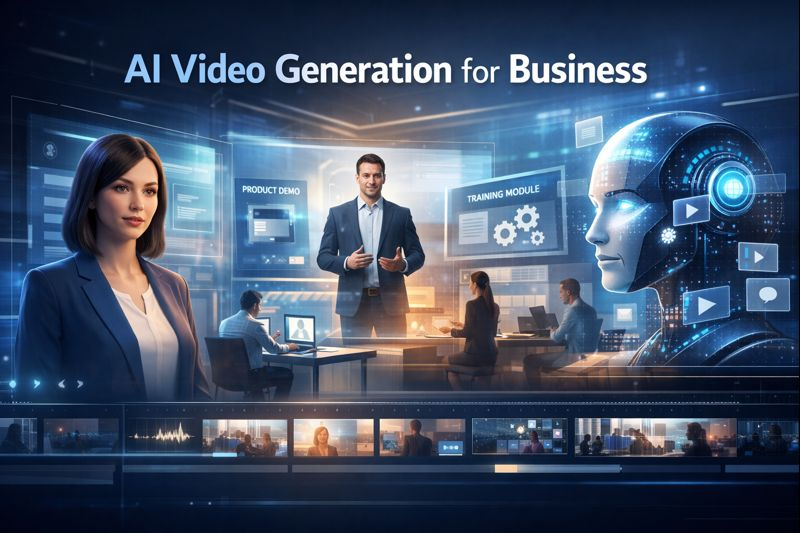
Video has become the dominant form of communication in modern business. Organizations use it to train employees, explain products, educate customers, support sales, and communicate internally. Yet the way most companies still produce video belongs to a slower era.
Traditional video production was built for campaigns, not continuous communication. It relies on crews, equipment, scheduling, editing cycles, and budgets that make sense only when content is created occasionally. But today’s enterprises don’t need occasional video. They need video constantly.
This is where AI video generation for business is changing the equation.
The Growing Communication Gap Inside Enterprises
Businesses are producing more information than ever before. Policies update regularly. Products evolve quickly. Training materials must stay current. Marketing messages adapt to different audiences. Global teams need localized communication.
The problem is not a lack of information. It is the inability to transform that information into accessible formats at the same speed it is created.
Documents pile up. Presentations go unread. Long emails are ignored. Meanwhile, audiences increasingly expect visual, guided communication that is easier to absorb.
A gap forms between what companies know and what people actually understand.
What AI Video Generation Means for Businesses
AI video generation allows organizations to convert written content into professional videos automatically. Instead of building a production process from the ground up, teams start with the information they already have.
A training document can become a structured learning video. A product explanation can turn into a visual demo. A policy update can be delivered through a guided presentation. The technology handles voice, visuals, and presentation, allowing teams to focus on the message itself.
Video creation shifts from being a production task to being a content workflow.
Why Traditional Video Production Can’t Keep Up
The traditional model of video production is built around scarcity. It assumes that video is expensive, time-consuming, and reserved for major initiatives. That assumption no longer aligns with business reality.
Enterprises now operate in environments where information changes weekly, sometimes daily. Training content must be refreshed. Sales materials must be adapted for industries and accounts. Compliance communication must be updated quickly.
When every update requires reshooting, re-editing, and reorganizing production resources, video becomes a bottleneck instead of an enabler. AI video platforms remove that bottleneck by allowing content to be regenerated as easily as text is edited.
From Static Documents to Dynamic Communication
One of the most significant shifts enabled by AI video generation is the transformation of static information into dynamic experiences. Written materials remain essential, but they no longer need to be the final format.
Visual explanations improve retention. Guided presentations make complex topics easier to follow. Human-like AI presenters add structure and clarity to information that might otherwise feel overwhelming.
This is especially important in areas such as corporate training, customer education, legal communication, and technical documentation, where clarity directly affects outcomes.
Scaling Communication Across Teams and Regions
Large organizations face a scaling challenge. The more they grow, the more communication multiplies. More roles, more processes, more regions, more languages.
Traditional production methods struggle under this weight. AI-driven video generation introduces a scalable layer that can adapt the same core message for different audiences without rebuilding content from scratch. Communication becomes modular and repeatable rather than one-off and resource-heavy.
This allows businesses to maintain consistency while still adapting to local and functional needs.
AI Avatars and the Human Element
Modern AI video platforms often include digital presenters that deliver information in a structured and engaging way. These AI avatars bring a human presence to communication without requiring on-camera talent for every update.
For businesses, this means executive messages, training sessions, and product explanations can maintain a professional and consistent presentation style across large volumes of content. The human element remains, but the production constraints are reduced.
Supporting Digital Transformation Through Content Automation
Digital transformation is not only about systems and data. It is also about how information flows inside and outside the organization. If communication remains slow and manual, other transformation efforts lose impact.
AI video generation introduces automation into one of the most resource-intensive areas of business communication. By reducing production friction, organizations can share knowledge faster, keep teams aligned, and respond more quickly to change.
This is where AI shifts from being an experimental tool to becoming part of operational infrastructure.
The Future of Business Communication
The direction is clear. Communication is becoming more visual, more frequent, and more personalized. Businesses that rely solely on traditional production models will struggle to keep pace with the demand.
AI video generation enables a different model, one where content can evolve continuously alongside the business itself. Information becomes easier to understand, faster to distribute, and simpler to update.
Organizations that embrace this shift are not just improving video production. They are redefining how communication works at scale.