Introduction
Business communication is undergoing one of the biggest transformations since the rise of the internet. Organizations are no longer competing solely on products, pricing, or operational efficiency. They are competing on how effectively they communicate with customers, employees, partners, and stakeholders across an increasingly digital world.
The challenge is scale. Modern enterprises must create content for multiple markets, languages, customer segments, and communication channels while maintaining brand consistency. Traditional content production methods are unable to keep pace with these demands.
This challenge has created a new category of technology: the Enterprise AI Content Engine.
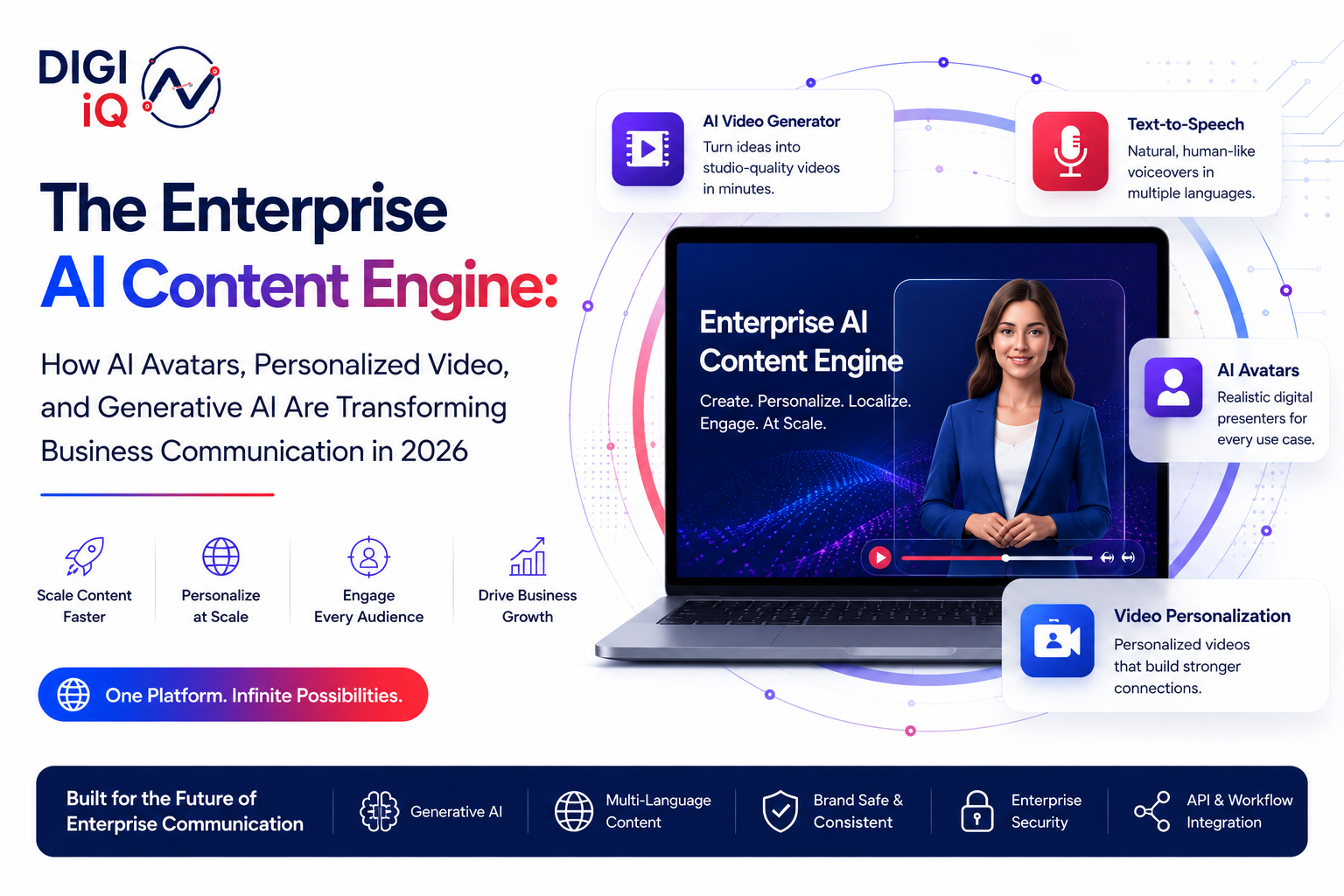
Powered by generative AI, AI avatars, video personalization, and text-to-speech technology, enterprise content engines are helping organizations produce, localize, personalize, and distribute communication at a scale that was previously impossible.
As businesses move deeper into the AI era, organizations that adopt intelligent content infrastructure will gain significant advantages in customer engagement, employee communication, training, marketing, and operational efficiency.
Why Traditional Content Workflows Are Breaking Down
Most enterprise content workflows were designed for a different era. Marketing teams create campaigns. Training departments produce learning materials. Corporate communication teams manage internal messaging. Customer success teams build onboarding content.
These departments often operate independently, creating duplicate efforts and inconsistent messaging.
As businesses expand globally, the complexity increases further. A single announcement may need to be adapted for multiple languages, regions, products, and audience segments. What was once a straightforward communication task becomes a resource-intensive process involving writers, designers, editors, translators, voice artists, and video production teams.
The result is slower execution, rising costs, and fragmented customer experiences.
Generative AI is changing this model by enabling content creation at unprecedented speed and scale.
The Rise of Enterprise AI Content Engines
An Enterprise AI Content Engine serves as a centralized system that transforms ideas into multiple content formats automatically.
Instead of creating content separately for every platform, organizations can generate videos, voiceovers, presentations, personalized messages, training materials, and marketing assets from a single source of information.
This approach allows companies to maintain brand consistency while dramatically increasing production capacity.
Rather than replacing human creativity, AI amplifies it. Teams spend less time on repetitive production tasks and more time focusing on strategy, innovation, and audience engagement.
The result is faster communication cycles and stronger business outcomes.
AI Video Generation Is Becoming a Core Business Capability
Video has become the preferred communication format for modern audiences. Customers engage more with video. Employees retain information better through video-based training. Sales teams achieve stronger conversion rates with visual communication.
However, traditional video production remains expensive and time-consuming.
AI Video Generator technology is changing that reality.
Businesses can now transform scripts, presentations, product information, training materials, and marketing messages into professional-quality videos within minutes.
This capability enables organizations to produce significantly more content without increasing production costs.
Marketing teams can create campaign videos faster. Sales teams can generate personalized presentations. Human resources departments can produce onboarding content. Training teams can update educational materials instantly whenever policies or procedures change.
The result is a more agile organization capable of communicating at the speed of business.
AI Avatars Are Redefining Digital Communication
One of the most significant developments in enterprise communication is the emergence of AI Avatars.
AI avatars function as digital presenters capable of delivering messages naturally and consistently across multiple channels.
Unlike traditional presenters, AI avatars can communicate in different languages, adapt messaging for specific audiences, and remain available around the clock.
Organizations are increasingly using AI avatars for employee training, customer onboarding, internal communication, product demonstrations, and marketing campaigns.
Because the avatar maintains a consistent appearance and communication style, companies can strengthen brand recognition while reducing production complexity.
For global organizations, AI avatars also help overcome localization challenges by delivering content tailored to regional audiences without requiring entirely new productions.
The Power of Video Personalization at Scale
Personalization has become one of the strongest drivers of engagement in digital communication.
Customers increasingly expect experiences tailored to their needs, interests, and behaviors. Generic communication often struggles to capture attention in crowded digital environments.
Video Personalization technology allows organizations to create highly relevant experiences for individual viewers.
Instead of sending the same video to every customer, businesses can dynamically customize content using customer data, industry information, purchase history, geographic location, or engagement patterns.
This level of personalization creates stronger emotional connections and improves communication effectiveness.
Sales teams can create personalized outreach videos. Customer success teams can deliver customized onboarding experiences. Marketing teams can generate individualized campaign content for thousands of prospects simultaneously.
The result is higher engagement, improved conversions, and stronger customer relationships.
Text-to-Speech Is Accelerating Global Content Creation
Voice remains one of the most powerful communication channels available to businesses.
Whether creating training programs, marketing videos, podcasts, product demonstrations, or customer support materials, organizations require high-quality voice content.
Text-to-Speech technology has evolved dramatically in recent years.
Modern AI-generated voices sound increasingly natural, expressive, and human-like. Organizations can transform written content into professional voiceovers within minutes while maintaining consistency across multiple projects.
For global enterprises, this capability becomes even more valuable.
Content can be localized into multiple languages without requiring separate voice recording sessions for every region. Businesses can accelerate international expansion while ensuring consistent messaging worldwide.
As a result, text-to-speech technology is becoming a foundational component of enterprise communication infrastructure.
Narrative Intelligence and the Future of Business Storytelling
Beyond content generation lies a more strategic capability known as Narrative Intelligence.
Narrative intelligence focuses on understanding how stories, messages, and communication influence audience perception.
Organizations are beginning to recognize that data alone rarely changes behavior. Stories create emotional engagement, trust, and action.
AI systems can now analyze communication effectiveness, identify emerging audience interests, and recommend narrative approaches that resonate more effectively with specific groups.
This capability helps businesses create stronger connections with customers, employees, investors, and partners.
As communication becomes increasingly automated, narrative intelligence ensures that human meaning remains at the center of every interaction.
Why AI Consulting Is Becoming Essential
Technology adoption alone does not guarantee success.
Many organizations invest in AI tools without establishing clear strategies, governance frameworks, or implementation roadmaps.
This challenge has increased demand for AI Consulting Services that help businesses align AI initiatives with operational goals.
AI consultants assist organizations in identifying opportunities, evaluating technology solutions, developing implementation strategies, and measuring business impact.
For small and mid-sized businesses, expert guidance can significantly reduce implementation risks while accelerating results.
As AI becomes integrated across marketing, communication, operations, and customer experience functions, strategic consulting will play an increasingly important role in successful transformation initiatives.
The Competitive Advantage of Integrated AI Platforms
The next generation of enterprise communication will not rely on isolated AI tools.
Organizations are moving toward integrated platforms that combine content generation, AI avatars, video personalization, voice synthesis, localization, and workflow automation within a unified ecosystem.
This integrated approach creates operational efficiency while enabling consistent communication across every customer touchpoint.
Businesses can produce content faster, personalize experiences more effectively, enter new markets more confidently, and respond to changing conditions with greater agility.
The organizations that build these capabilities today will establish significant competitive advantages tomorrow.
Conclusion
The future of business communication is not simply about creating more content. It is about creating smarter, more personalized, and more scalable communication experiences.
AI video generation, AI avatars, video personalization, text-to-speech technology, and generative AI platforms are rapidly becoming essential business infrastructure.
Organizations that embrace these capabilities can improve customer engagement, strengthen internal communication, accelerate content production, and expand globally with greater efficiency.
As enterprises continue their digital transformation journeys, the Enterprise AI Content Engine will become the foundation of how modern organizations communicate, connect, and grow in the AI-driven economy.