Introduction
Businesses today operate in a global digital environment where audiences come from different countries, cultures, and languages. For companies that want to expand internationally, effective communication is essential. However, reaching global audiences requires more than simply translating text. Businesses must adapt their content, messaging, and visual communication to match the cultural expectations and language preferences of different markets.
Traditional localization processes can be slow, expensive, and difficult to scale. Companies often rely on translation teams, voice actors, and regional marketing specialists to adapt content for different regions. While this approach can produce high-quality results, it becomes challenging when organizations need to produce large volumes of content across multiple platforms.
Artificial intelligence is transforming this process by enabling automated content localization. With AI-powered tools, businesses can quickly adapt their content into multiple languages while maintaining consistent messaging and branding. This technology allows organizations to reach global audiences faster and more efficiently than ever before.
Platforms like DigiiQ.ai are helping businesses implement AI-driven localization strategies that simplify global communication and allow companies to scale their content production across international markets.
The Importance of Localization in the Digital Economy
As digital platforms connect businesses with customers worldwide, localization has become an essential part of international marketing strategies. Consumers prefer content that is presented in their native language and reflects their cultural context. Studies consistently show that people are more likely to engage with brands that communicate in a familiar language.
Localization involves more than translating words. It requires adapting tone, visuals, and messaging so that content resonates with a specific audience. For example, marketing campaigns that work well in one region may not have the same impact in another due to cultural differences.
For global organizations, this creates a significant challenge. Every new market requires additional content production, translation, and communication strategies. Managing this process manually can slow down expansion and increase operational costs.
AI-powered localization solutions are helping businesses overcome these challenges by automating many aspects of the content adaptation process.
How AI Simplifies Multilingual Content Creation
Artificial intelligence can analyze large datasets of language patterns and translation models to generate accurate multilingual content. AI systems use natural language processing to understand context, grammar, and meaning, allowing them to produce translations that sound natural and clear.
Instead of relying on manual translation for every piece of content, businesses can generate multilingual versions of their content automatically. This significantly reduces the time required to launch international campaigns or communicate with global audiences.
AI-powered localization platforms can also adapt marketing messages to different regions by adjusting tone and phrasing to match local communication styles. This ensures that content remains relevant and engaging regardless of where it is viewed.
By integrating AI localization into their workflows, businesses can create global communication strategies that are both efficient and scalable.
AI Video Localization and Global Communication
Video content has become one of the most effective forms of digital communication. Businesses use videos to explain products, educate customers, and deliver training materials. However, creating multilingual video content has traditionally been difficult.
Producing a video in multiple languages usually requires separate recordings, voiceovers, and editing processes for each version. This makes large-scale video localization expensive and time-consuming.
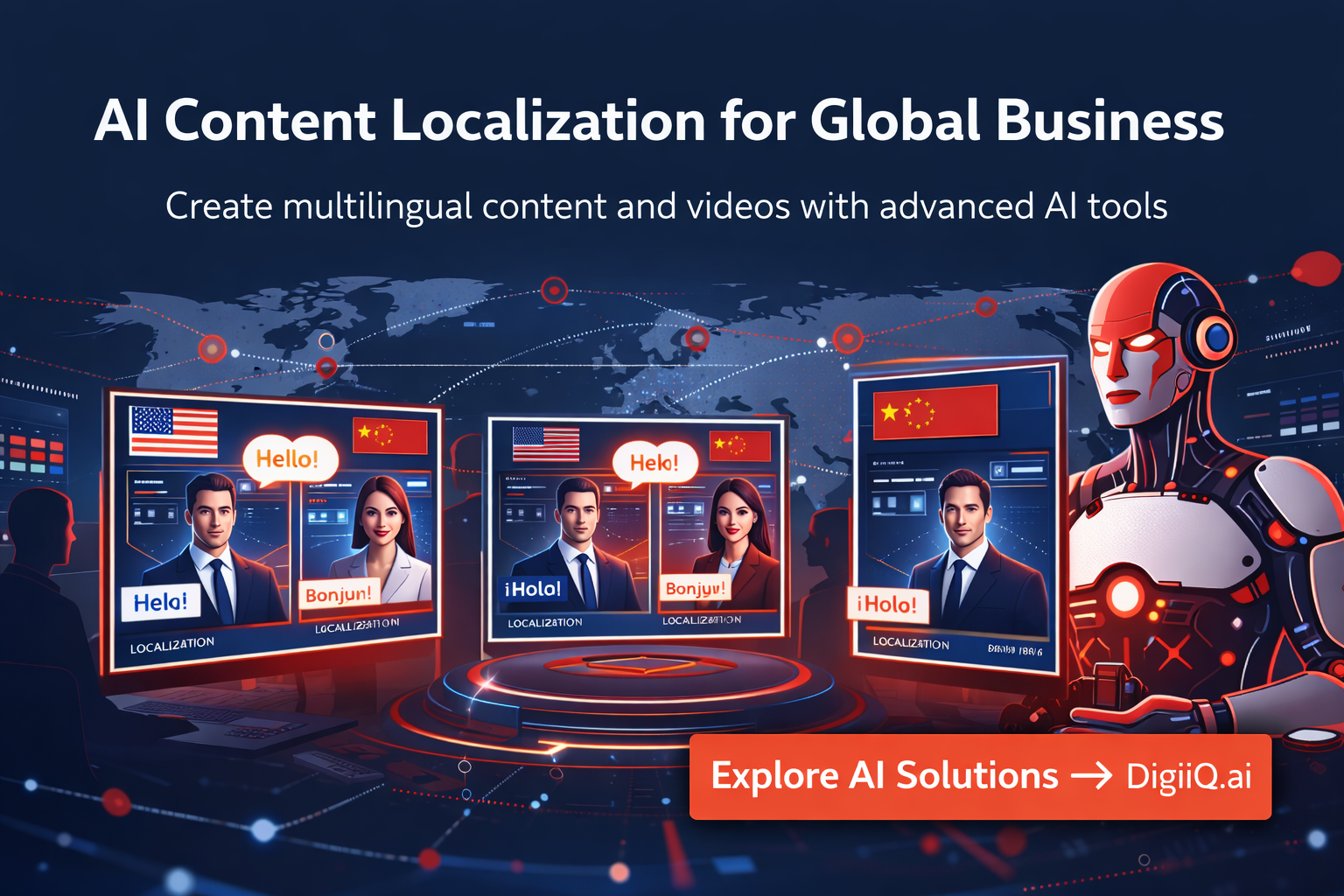
AI-powered video platforms solve this problem by allowing businesses to generate localized video presentations automatically. A single script can be converted into multiple languages, and AI-generated voice narration can deliver the message in each language.
With solutions like DigiiQ.ai, organizations can transform text into multilingual videos that maintain consistent branding and presentation quality across different regions. This capability allows businesses to expand their global communication strategies without dramatically increasing production costs.
Improving International Marketing Strategies
Localization plays a crucial role in digital marketing success. When businesses communicate with audiences in their preferred language, they build stronger relationships and increase customer trust.
AI-powered localization tools enable marketing teams to launch international campaigns more quickly. Instead of spending weeks preparing localized materials, organizations can generate multilingual marketing assets in a fraction of the time.
This speed gives companies a competitive advantage when entering new markets. Businesses can respond to regional trends, launch campaigns simultaneously across multiple countries, and adapt their messaging based on audience feedback.
By using AI-powered platforms, marketing teams can focus more on strategy and creativity while automation handles the technical aspects of localization.
AI Localization for Training and Corporate Communication
Global organizations often face challenges when delivering internal communication and training programs to employees in different countries. Language barriers can create misunderstandings and reduce the effectiveness of training materials.
AI localization technology enables companies to produce multilingual training content that employees can easily understand. Written materials can be translated automatically, and video training programs can be generated in multiple languages.
This approach ensures that employees receive consistent information regardless of their location. It also reduces the need for multiple training sessions and allows organizations to deliver educational resources more efficiently.
With platforms like DigiiQ.ai, companies can create scalable training solutions that support international teams and maintain consistent knowledge sharing across the organization.
The Future of AI-Powered Global Communication
Artificial intelligence will continue to transform global communication in the coming years. Advances in language models, voice synthesis, and real-time translation will make it possible for businesses to interact with audiences across languages instantly.
Future AI platforms may enable live multilingual presentations, interactive digital assistants, and automated video localization that adapts content dynamically for different regions.
These innovations will allow organizations to connect with global audiences in ways that were previously impossible. Companies that invest in AI-driven communication tools today will be better prepared to compete in the increasingly global digital marketplace.
DigiiQ.ai represents one of the emerging solutions that help businesses embrace this transformation by providing intelligent tools for scalable content creation and multilingual communication.
Conclusion
Global expansion requires effective communication with diverse audiences. Traditional localization methods often struggle to keep up with the growing demand for multilingual content in the digital economy.
Artificial intelligence is revolutionizing the localization process by automating translation, content adaptation, and video generation. Businesses can now produce global communication materials faster, more efficiently, and at a larger scale.
Platforms like DigiiQ.ai enable organizations to leverage AI technology to create multilingual videos, localized marketing campaigns, and scalable training programs. By adopting AI-powered localization solutions, businesses can strengthen their global presence and connect with audiences worldwide.