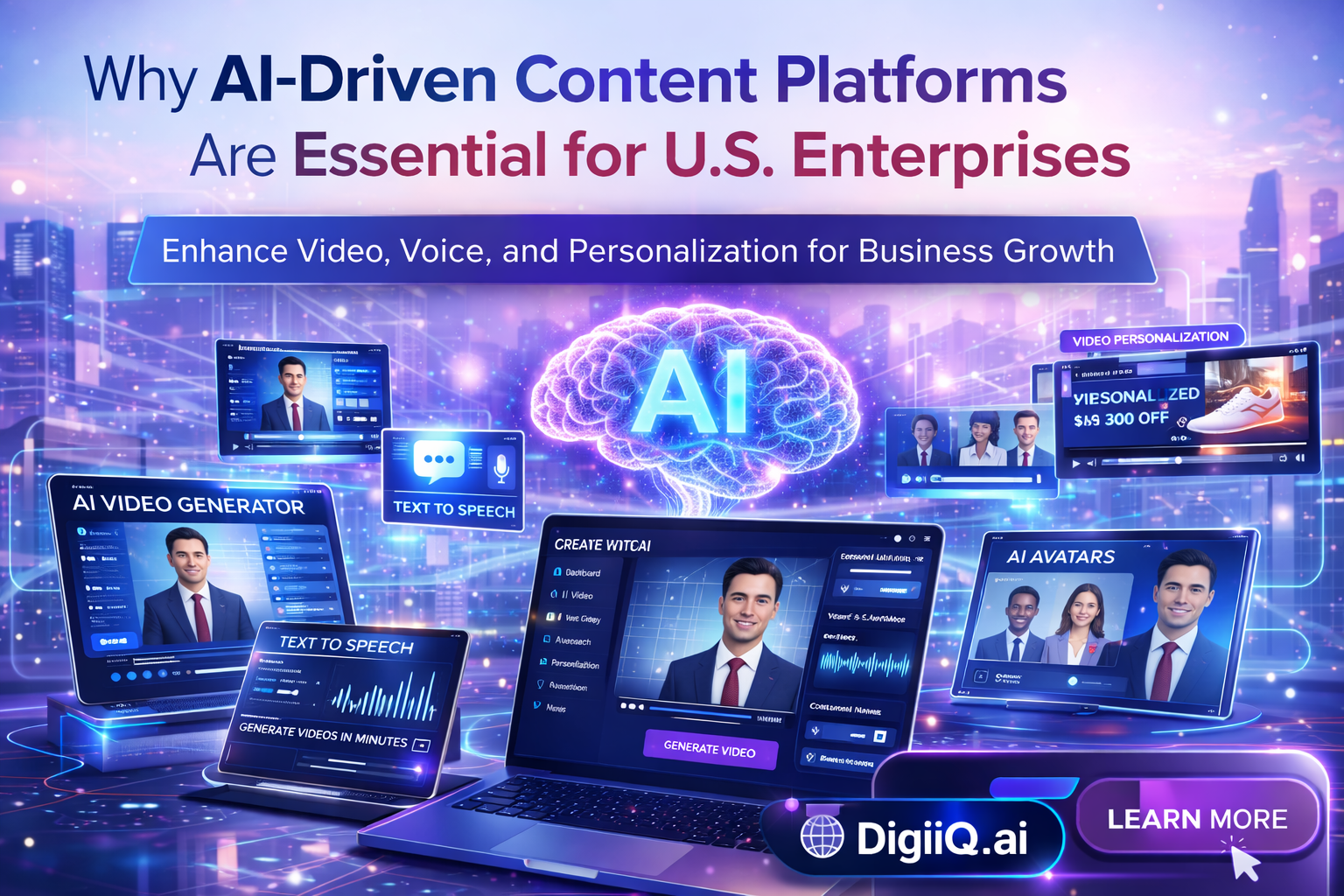
Introduction: The Era of Intelligent Business Communication
The way businesses communicate has fundamentally changed in the United States. What once relied on static content, manual processes, and delayed execution has now evolved into a dynamic, real-time ecosystem powered by intelligent technologies. Enterprises are no longer competing only on products or services; they are competing on how effectively they communicate their value.
Content sits at the center of this transformation. Whether it is a marketing campaign, a sales pitch, a customer onboarding experience, or internal communication, content determines how a brand is perceived. However, the challenge is no longer about creating content alone. It is about creating the right content at scale, with speed, personalization, and consistency.
Artificial intelligence is addressing this challenge by introducing a new generation of content platforms that automate workflows and enhance creativity. Platforms like DigiiQ.ai are enabling businesses to convert simple inputs into powerful digital experiences, including videos, voice content, avatars, and personalized communication assets. This shift is redefining how U.S. enterprises operate and grow in an increasingly competitive digital landscape.
The Growing Complexity of Content Operations
As businesses expand, their content needs grow exponentially. Marketing teams require campaigns tailored for different audiences, sales teams need personalized materials for prospects, and customer support teams depend on clear communication to resolve issues efficiently. At the same time, internal teams rely on content for training, collaboration, and knowledge sharing.
Managing these diverse requirements can quickly become overwhelming. Traditional content workflows involve multiple stages such as ideation, writing, design, approval, and distribution. Each stage requires coordination across teams, which often leads to delays and inefficiencies.
Another major challenge is maintaining consistency. With different teams working on various types of content, ensuring a unified brand voice becomes difficult. Inconsistent messaging can weaken brand identity and reduce customer trust.
AI-driven content platforms simplify these operations by automating repetitive tasks and standardizing workflows. This allows businesses to focus on strategy and creativity rather than manual execution.
AI Video Generation as a Business Accelerator
Video content has become one of the most powerful tools for communication in the digital age. It combines visual storytelling with clear messaging, making it easier for audiences to understand and engage with information.
However, traditional video production is resource-intensive. It requires scripting, filming, editing, and post-production, all of which can take significant time and effort. For enterprises that need to produce content regularly, this process can become a major bottleneck.
AI video generation eliminates these challenges by enabling businesses to create videos directly from text inputs. This approach drastically reduces production time and allows companies to produce content on demand.
With AI-powered video tools, businesses can create product demonstrations, marketing campaigns, training materials, and customer communication assets quickly and efficiently. This capability not only improves productivity but also ensures that organizations can respond to market changes in real time.
Voice Technology and Its Impact on Accessibility
In addition to video, voice technology is playing a crucial role in modern communication. Audio content is widely used in training programs, customer support systems, and digital applications.
AI-powered text-to-speech solutions enable businesses to convert written content into natural-sounding audio. This eliminates the need for manual voice recording and allows companies to generate voice content instantly.
Voice technology enhances accessibility by providing an alternative way for users to consume information. It also improves engagement by making content more interactive and dynamic.
For U.S. enterprises that serve diverse audiences, including individuals with different preferences and needs, voice technology offers a powerful way to deliver inclusive and effective communication.
Personalization at Scale: Meeting Customer Expectations
One of the defining characteristics of modern business communication is personalization. Customers expect brands to understand their needs and provide content that is relevant to them.
Delivering personalized content manually is both time-consuming and resource-intensive. AI solves this problem by enabling businesses to generate customized content at scale.
AI-driven platforms can analyze user data and create multiple variations of content tailored to different audience segments. This allows businesses to deliver targeted messages that resonate with their audience.
For example, a company can create personalized video messages for individual customers, addressing their specific needs and preferences. This level of customization improves engagement and increases the likelihood of conversion.
Personalization is no longer a luxury; it is a necessity for businesses that want to succeed in the competitive U.S. market.
AI Avatars and the Humanization of Digital Content
Human interaction plays a critical role in building trust and engagement. However, scaling human communication across large audiences is challenging.
AI avatars provide a solution by enabling businesses to create digital presenters that deliver messages in a natural and engaging manner. These avatars can be used for a wide range of applications, including marketing, training, and customer support.
Unlike traditional presenters, AI avatars can be deployed at scale without additional production efforts. Businesses can create consistent and professional content without the need for repeated recordings.
AI avatars also enable multilingual communication, allowing companies to reach diverse audiences without additional resources. This capability is particularly valuable in the United States, where businesses must cater to a wide range of cultural and linguistic backgrounds.
Integrating AI into Business Workflows
The true power of AI-driven content platforms lies in their ability to integrate seamlessly with existing business systems. By connecting with tools such as customer relationship management systems and marketing automation platforms, AI enables businesses to create a continuous flow of content.
For example, customer data can trigger the creation of personalized content, which can then be distributed automatically through marketing channels. This level of automation reduces manual effort and ensures that content is delivered at the right time.
Integration also improves collaboration by providing a centralized platform where teams can work together. This reduces duplication of effort and ensures that everyone has access to the latest content.
Cost Efficiency and Return on Investment
Content production can be a significant expense for businesses, especially when it involves video creation, design, and multiple revisions. AI-driven platforms reduce these costs by automating key processes and minimizing the need for large teams.
Businesses can produce more content with fewer resources, improving their return on investment. AI also allows companies to experiment with different content strategies without incurring high costs.
For example, marketing teams can test multiple versions of a campaign to determine which one performs best. This data-driven approach helps optimize content and maximize results.
The Future of AI-Driven Content Platforms
As artificial intelligence continues to evolve, its impact on content creation will only grow stronger. Future advancements will enable businesses to generate real-time content, adapt messaging dynamically, and create immersive digital experiences.
AI will also play a key role in improving decision-making by providing insights into content performance and audience behavior. This will allow businesses to refine their strategies and achieve better outcomes.
Companies that adopt AI-driven content platforms early will gain a significant competitive advantage. They will be able to operate more efficiently, respond quickly to changes, and deliver superior customer experiences.
Conclusion: Transforming Business Communication with DigiiQ.ai
The rise of AI-driven content platforms marks a new chapter in business communication. By automating workflows and enabling intelligent content creation, AI is helping enterprises overcome the challenges of scale, speed, and personalization.
DigiiQ.ai stands at the forefront of this transformation, providing businesses with the tools they need to create high-impact videos, voice content, avatars, and personalized communication assets. By simplifying complex processes and delivering powerful results, it empowers organizations to focus on growth and innovation.
As the demand for content continues to rise, businesses that embrace AI-driven solutions will be better equipped to succeed in the digital age. The future of communication is intelligent, scalable, and personalized, and DigiiQ.ai is leading the way in making that future a reality.
FAQs
1. What are AI-driven content platforms?
AI-driven content platforms use artificial intelligence to create videos, voice content, and digital assets automatically. They help businesses streamline workflows and scale content production efficiently.
2. How do AI video tools benefit U.S. enterprises?
AI video tools enable businesses to create professional videos instantly from text. This reduces production time, lowers costs, and improves engagement across marketing and sales channels.
3. What role does text-to-speech play in business communication?
Text-to-speech technology converts written content into natural audio. It enhances accessibility, improves user experience, and allows businesses to deliver consistent voice communication at scale.
4. How does AI personalization improve customer engagement?
AI personalization allows businesses to create tailored content for individual users. Personalized videos and messages increase engagement, build trust, and boost conversion rates.
5. What are AI avatars and why are they important?
AI avatars are digital presenters that deliver content in a human-like manner. They help businesses create engaging communication for training, marketing, and customer support without repeated production.
6. Why should businesses choose DigiiQ.ai?
DigiiQ.ai provides an all-in-one platform for AI video generation, voice content, personalization, and avatars. It helps businesses create scalable, high-quality content quickly and efficiently.